Tuesday, June 20, 2017

Fraunces Tavern

Predictions/Inquiries:
  • I predict that I'll learn more about Fraunces Tavern's role in Revolutionary America.

Outside Fraunces during the Flag Day
Celebration
At Fraunces:
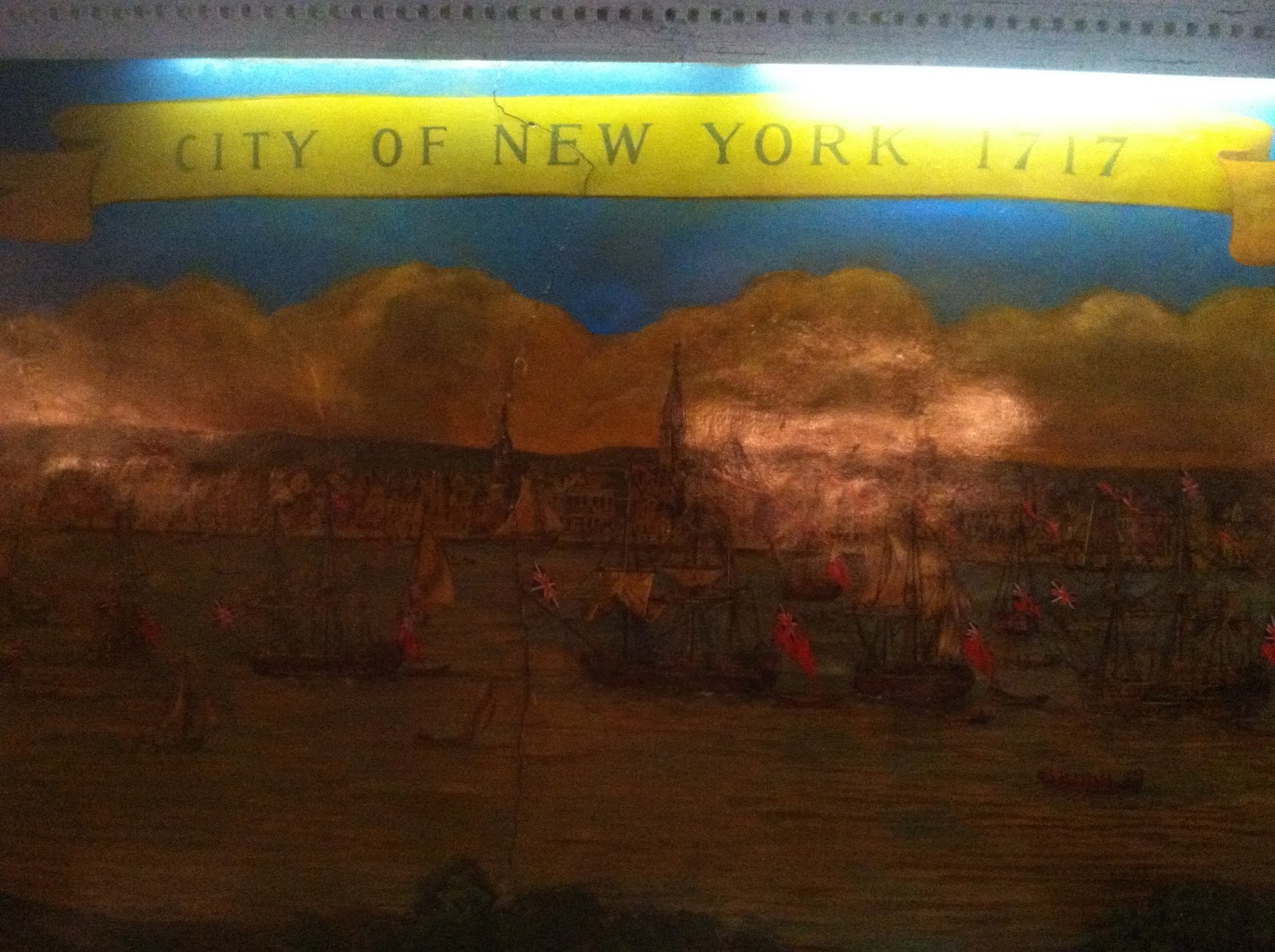
Among the many surprises on my New York adventure was the significant presence of American Revolutionary history in the City.  There are sites from Harlem to the Battery that range from museums to monuments including four that I saw in my travels alone.  After the Battle of Harlem Heights, in September, 1776, the city was occupied by the British until the end of the war.  Even before the war, the city was largely Loyalist.  Nevertheless, since Evacuation Day on November 25, 1783 NY has embraced and promoted a strong Patriotic presence.  Today in New York, Fraunces Tavern and Museum are at the forefront of this presence.


Me with Revolutionary War
Reenactor, Ken
This was a three part stop: a) Flag Day parade and ceremony celebrating "Old Glory" and its history; b) a meal in the historic pub; c) a visit to the Fraunces Museum.   This was a great stop filled with good food, interesting people, rich history, and a couple surprises.

Here are the historic facts important to know about Fraunces Tavern:
  • A building was first constructed on the Fraunces lot in 1719
  • In 1762 Samuel Fraunces purchases the property and open it as Queens Head Tavern
    • An, interesting note on Fraunces is that only one painting exists that is considered to be him though it is not certain.  There is some speculation around his race as his nickname was "black Sam."  However, based on a 1712 law that I came across at the African Burial Ground which reads, "No Negro, Indian, or Mulatto made free henceforth shall be allowed to own property in the colony of New York," the possibility of Fraunces being black seems unlikely.  
  • In 1775 the Sons of Liberty planned the New York Tea Party here.  
  • Tavern hit by British canon fire in 1775.
  • Washington gave his famous farewell to his officers in the Long Room here in 1783.  This room is on display in the museum.  
  • The building housed the War Department, the Treasury, and Foreign Affairs Department while the U.S. Capital was in NYC.
  • In 1804, a week before their duel, Burr and Hamilton met here as part of the Society of Cincinnati.  
If you look close, you can see a crack left by the '75 bombing.
A lesser known story, not advertised in the guidebooks, or represented in the Fraunces sponsored literature, though my Irish bartender told me about it, the middle aged women sitting next to me knew about it, and there is a plaque in a back room acknowledging it, is the bombing that took place in the Tavern in 1975.  This was one of the most intriguing discoveries that I had on the entire trip, and was the second NYC bombing in two days that I learned of.  The bombing was carried out by Fuerzas Armadas de Liberacion Nacional Puertoriquena (Armed Forces of Puerto Rican National Liberation), another group I never heard of, and who is tied to around 100 bombings in NYC.  The Fraunces bombing killed four people and injured another forty-four.  Below is the FALN's Communique released in the aftermath of the attack:

Also interesting about Fraunces is who owns it today:  The Sons of the Revolution.  Their mission is "to engage with State Societies in activities which further the education of the general public (especially America's youth) about the American Revolution and the United States Constitution and about the patriots who supported those worthy causes during the period of 1775-1789."  Hence the Flag Day Celebration that I happened upon on the street in front of Fraunces.  Their membership is limited to "any male of good character" who is a direct descendent of a Patriot who officially participated in the Revolutionary cause.  The group, formed at Fraunces Tavern in the late 1800s, was created around the idea that

"... the steady decline of a proper celebration of the National Holidays of the United States of America, that popular concern in the events and men of the War of the Revolution is gradually declining, and that such lack of interest is attributable, not so much to the lapse of time and the rapid increase of immigration from foreign countries, as to the neglect, on the part of descendants of Revolutionary heroes, to perform their duty in keeping before the public mind the memory of the services of their ancestors and of the times in which they lived."

So, basically you have a group of wealthy, old, white, men (pictures of their meetings support this) promoting their great white ancestors.  It's interesting that they mention immigration in the above statement of purpose, but at the same time not that it is not the biggest factor in the decay of American history.  Nevertheless, this group has serious capital, owning an entire block that includes five buildings in Lower Manhattan, valuable artifacts displayed in their museum, and assets beyond.  Seventeen U.S. Presidents have been a member of the group. While the politics of the Sons is not transparent, though six out of the last ten member-Presidents were Republican, from their history, it's easy to assume a crusty conservative leaning.  They are doing a great thing in the preservation of American history though their narrative is rather Whiggish in interpretation.  It's interesting that FALN chose Fraunces tavern as a target in their retaliatory action, and on the surface it doesn't make sense.  But digging a little deeper, I imagine it was because of the likely conservative politics and power of the Sons coupled with the place of Fraunces in America's own Freedom struggle that the Tavern was selected.


Resources:

Monday, June 19, 2017

Bob Dylan

Predictions:

  • Bob Dylan will cover a wide spectrum of his catalog, thus covering nearly 60 years of music and of American history.  
  • If Dylan plays some of the 40+ standards he's recorded over the last five years he'll reach even further back into music history.  


At the Show:

On Father's Day I took my daughter to see "the real Bob Dylan," to allow her the experience of seeing one of the most important musicians in the history of American music.  This was the sixth time I've seen him over the last twenty years and the first time in the last five years.  Since I last saw him, he has put out three albums (one of them a triple album) of "classic American songs."  Dylan was energetic and hammed it up somewhat during his crooning
numbers.  His voice was gravelly, though clear.  Unfortunately, the crowd was low-key and it seemed that aside from a guy spinning dervish-like in the lobby, and a few fans up close, they came to the Oakdale to see an important artifact.  Fittingly, Dylan's response seems to be, "if you want an artifact, I'll give you artifacts."  So you have an old singer singing even older songs.  Being somewhat of a Dylanologist, I wouldn't be surprised if this is deliberate.

The setlist was phenomenal, including my favorite, "Ballad of a Thin Man," and the epic, "Desolation Row," which Dylan once proclaimed that if he was ever elected President (not out of the question these days) he would make it the national anthem.  The song gets right to it, "They're selling postcards of the hanging," likely referring to the images of lynching that circulated in the South on postcards during Jim Crow.  Dylan is known for his persistent tinkering with and reinterpretation of his songs which was evident in the two most famous songs he played, "Blowin' in the Wind," and "It Ain't Me Babe." Hearing Bob Dylan sing "Blowin in the Wind," the anthem of the sixties, is worth the price of admission for the Dylan enthusiast and the historian alike.  My guess is that people don't go to see Dylan play American standards such as Sinatra's "All or Nothing at All" or Tony Bennett's "Once Upon a time," but the sound and the songs add an interesting layer to the shows.  To look around the Oakdale and see the age range of fans at the show speaks to the timelessness of Dylan's words and supports his recent selection as Nobel Poet Laureate.   Whether written yesterday or fifty years ago, the songs resonate with listeners in ever-evolving ways and truly get at the heart of the American spirt and American character.

Resources:
"Desolation Row" Lyrics
Setlist from the show

Zuccotti Park

At the Park:
I put Zuccotti Park on my itinerary for its part in the Occupy Wall Street Movement in 2011. From September 17, 2011 to September 17, 2012 the park served as an encampment for the Occupy protestors. Given the substance of the protest (anti-big business) the location of the park (NY's financial district), and the ownership of the park (privately owned by Brookfield Office Properties) my prediction was that I would find no evidence of the Occupy Movement there. After a walk around and through, my prediction was confirmed. The only acknowledged connection of Zuccotti Park to history was the bronze sculpture titled, "Double Check," at the northeast corner of the Park, which was damaged due to it vicinity to the World Trade Center on September 11, 2001 (see photos below).


In the absence of any info connected to Occupy, I sought out a food vendor on the square and asked him if he'd been around when the event was going on. The vendor, Mohammed Ali is his name, said "yes," he was visibly and audibly unimpressed with my question, but he went on to voice his frustration with the movement and the people involved as he was displaced during the event and lost significant income over the course of the occupation. He went on to share with me an article about him that was published in the local Tribeca Trib, that placed him in an earlier battle for space in 2008. He had a second article on hand published in the New York Times, which he, for whatever reason, refused to share with me. Back at home, I was able to recover the NYT article which was an extension of the Trib article. As it turns out, Ali went toe to toe with Greenmarket, a group that organizes farmers markets in the City. Greenmarket's mission is to "to promote regional agriculture by providing small family farms the opportunity to sell their locally grown products directly to consumers, and to ensure that all New Yorkers have access to the freshest, most nutritious locally grown food the region has to offer." In the food vendor-Greenmarket conflict, Ali was confronted by police as he refused to move his cart from his usual location, which Greenmarket, by permit, had begun staking claim to, and his cart was confiscated. The NYT article, comically titled, "In Pursuit of Justice--and the Hot Dogs," reported on Ali's lawsuit against the NYC Police who threw out all the food on his cart after confiscating it. Greenmarket has a current presence in Zuccotti park as well, though a compromise with that permits vendors to have a presence at the same time has been made.

Interesting about this whole thing is its tie to my inquiry on the history food and food sourcing in NY. As I prepared for that question I learned of the movement in NY to bring more fresh produce to the city and to grow more food there as well as on rooftops. However, underneath the somewhat romantic idea to eat fresh food is, in NYC at least, a class conflict. You have Ali, who lives in the Bronx and earns his daily bread on the sale of street meat and drink, and the high class New Yorkers' desire an improved diet.

Another interesting thing that I came across in my exploration was the naming of Zuccotti Park in 2006, after Chairman of Brookfield Properties, John Zuccotti. Until then, the park was known as Liberty Park. The Park, with its vicinity to the 9/11 Memorial and Freedom Tower, makes the name changing from an American ideal to a successful American businessman raises questions. One critic noted, "Taken in a local context, the label “Zuccotti Park” might be seen as a vestige of a boom-era race by Wall Street to remake the city’s most visible semi-public landmarks in its own name with infusions of capital." Another said “Zuccotti Park’s the slave name, to us it’s always Liberty Plaza.”

After a little digging, this little park (33,000 sq. ft.) revealed big and complex stories. Zuccotti has much to say about NY in regards to history, current trends, and ongoing conflicts.

Sources:
Here's a link to the Declaration of the Occupation of New York City.
Matt Harvey, Street Smart Reporting
Brookfied Properties
"Double Check,"days after 9/11
Inscription beside Double Check

Friday, June 16, 2017

Emily Dickinson House

Predictions/Inquiries:

  • The museum seems very focused on the literary aspect of Emily Dickinson's life.  What does it do with her historically or in the context of history?  
  • Why did neither of the Dickinson girls marry?  Was it anything to do with the partriarchy of the time and in their house in particular?
At the Museum:

In grad school, a professor put me on the task of establishing a relationship between Emily Dickinson of Amherst, and the Porter-Phelps-Huntington family of Hadley.  After 40+ hours of archival research I came up with nothing--that was the winter of 2005-06.  In the Dickinson gift shop today, the first thing I picked up was a thinly bound book titled something along the lines of "New Emily Dickinson Letter."  In the publisher's preface, he noted how rare it was to find a new Dickinson letter, and went on to explain that the letter was likely between Susan Phelps and Emily.  I say likely as it was simply addressed to "Sue" and not the other Susan in Dickinson's life, her best friend, neighbor, and sister in-law, whom she called something other than "Sue."  But there it was, a relationship established between Emily Dickinson and the Porter-Phelps-Huntington family, in a letter published in 2007.

The tour of the Dickinson house was uninspiring.  It was well organized and creatively worked in poetry, photography, and additional primary sources and material culture, but it largely skimmed the surface of Emily's life.  The house is minimally decorated in period furnishings with the exception of Emily's room.  The museum cast little light on Dickinson's significance to history, though her significance to literature was persistent.  Interesting was the publishing history that took place after Emily's death.  Her sister was surprised to find the amount that Emily had written and had the urge to publish.  As it turned out, there were several of her 2000+ poems that had multiple versions and word variations.  The first publication of her work was edited to meet the tastes of the average reader at the end of the 19th century. That has evolved since, but still, publication of her work remains, to a degree, editor's choice.

One lingering question I have is, was Mabel Loomis Todd, friend of Emily and mistress of brother Austin, related to the Loomis family in Windsor?  So here we are again, 11 years later, attempting to establish a familial relationship.

Resource:
Tips for educators considering the use of Dickinson in their classroom.

The Collect Pond


Unless urban history or the history of place are included under the umbrella of environmental history, my visit to the Collect Pond Park was the only part of my tour that broached the subject.  The Collect Pond was one of the surprise visits that I had happened upon between the African Burial Ground and the Museum of Chinese in America. In my preparation for the trip I had read about   So you could say that my prediction for this site was that it didn't exist and that the Pond was long forgotten.  The Collect Pond, once nearly 50 acres in size, served a significant recreational outlet, and water source for early settlers and was a means of sustenance for the Native Americans that preceded them.  By the 19th century the pond was contaminated and of no use so it was filled and built upon.  But that didn't last long as the fill was not stable and building began to sink and the rotting waste below began to stink.  No surprise, the former collect pond became one of the most notorious slums in American history--the Five Points District.   This building, demolishing, and stinking went on until 1941 when a the site was stabilized.  It returned to public use in 1960, and the water feature, seen below, was added in 2012.

Water feature at the Collect Pond Park
An 18th century romanticized view
of the pond.

The Park and the history of the area/pond say much about the city.  One thing that became clear over the course of my trip was the City's constant evolution and reinvention of itself.  The fact that this space has gone from a beautiful pond, to a dump, to a building site, and now to a park is evidence enough.  The value of public space was another persistent observation gathered over the course of my tour.  The NYC Department of Parks and Recreation boasts over 1700 public spaces that it maintains.  Thinking historically, beyond the various uses/functions of those spaces today is the back story on how they came to be and how different philosophies of their use has evolved and continues to evolve.  Intended or not, the reflection pools at the Collect Pond Park reflect far more than its patrons and its environs, they also reflect the ever evolving relationship between the land and the people that use it.


Monday, June 12, 2017

Where's the Santa Maria?

Predictions/Inquiries:
  • What is the purpose of the Columbus Foundation?
  • How is Columbus remembered in these "floating museums?"
  • Based on the website, my guess is that like the Nina, one of the "greatest little ships in the world's history," Columbus will be cast in a similar light.
On Board the Ships:
Apparently the Santa Maria was sunk on Christmas Eve of 1492 off the coast of Hispaniola--but we'll save that story for another day. It should be noted too however that the Nina and Pinta on hand in Hartford are recreations of the originals which is in fact the most interesting part of their story. As a few New England investors were investigating how to commemorate the 500th Anniversary of Columbus's "discovery" of America, they came across shipbuilders in Bahia, Brazil who were employing techniques from the 15th century. During the Age of Discovery, Brazil was founded by the Portuguese. Once Portugal ran out of wood, they sent their shipbuilders to Brazil. So began the reproduction of the Nina in 1988, utilizing shipbuilders and techniques descendent of the Age of Exploration. Pretty cool!

The purpose of the Columbus Foundation is to educate with their floating museum.  I asked one of the crewmen, an informative journeyman teacher, Dave, if the venture, which has travelled over 500,000 miles since 1988, has been confronted by the anti-Columbus movement.  He noted that there have been multiple instances but only one of note in Knoxville, TN. There, protestors yelled at the ship and crew for 30 minutes or so, calling them supporters of the genocidal maniac that Columbus was.  Dave had a different perspective on the matter, accusing the greed of Spanish nobility and hostile, barbaric and cannibalistic natives.  Interestingly, he also noted that Columbus Day was created by New England politicians to appease American-Italians.  Not sure of the validity, but that point certainly raises further questions...

If you're looking for an interesting
summer gig.
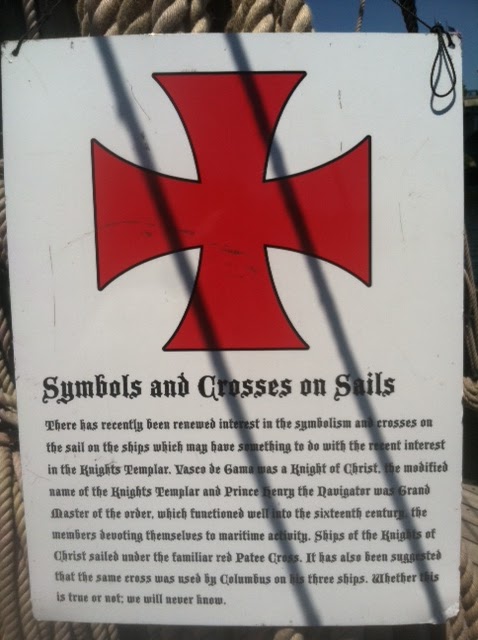
An interesting tie between exploration and
the Knights Templar.

Friday, June 9, 2017

Hancock Shaker Village

Predictions/Inquiries:
  • How did the physical world that the Shakers created for themselves, and the products that they created, reflect their spiritual beliefs?
  • Exteriorly, Shakers meticulously created a physical world that reflected their spiritual beliefs?  Were they successful in creating that same perfection within?  
  • What did they do to those whom challenged the rules?
At the Village:
The Hancock Shaker Village is one of the coolest historical places I've ever been.  Perhaps its my fascination with eighteenth century utopian societies or my own personal quest for spiritual wealth that made this museum so interesting.  Despite my lack of interest in following some Shaker beliefs, oddly, there was some sense of feeling at home in Hancock.

The physical world that the Shakers created reflected their spiritual beliefs in every way.  They sought to create heaven on earth and believed that all aspects of daily life and all life's tasks should be done to please God.  Thus peace, perfection, simplicity, efficiency, communal living, and a minimalist lifestyle were all the characteristics of Shaker life and work.   You can see this in the craftsmanship of their furniture and the architecture of their physical environment.  The Shakers believed that an "idle mind" was "the devil's workshop."

19th century meeting on Mt. Sinai near Hancock, with the
 "Lord's Stone" at center.
One of the highlights of the day was the opportunity to take part in Shaker song and dance (see the video at right).  As we performed a few of 10,000+ Shaker songs I learned that they always clapped on the right side of the body since the left side was seen as the evil side, but stomped with he left foot to "stamp the devil out."

Speaking of getting the devil out, I learned that there are only two known examples of community members breaking the celibacy rule.  There are several more examples of a Brother and a Sister leaving the community and ultimately marrying.  I was also intrigued to learn that in the late 19th century, as membership was declining, there was a long discussion about permitting sexual intercourse for the sole reason of procreation.  After deliberation, it was determined that such change would be too much of a departure from their core beliefs.  This lead to more departures.

This was an incredibly fulfilling stop as it was an opportunity to witness the beauty of the place, learn in great depth shaker beliefs, and practices, and to take part in the daily tasks of their life.  


Grave marker of a potential
Wilbury relative