Sunday, August 6, 2017

Castine Historical Society


Predictions/Inquiries:
  • There will be a focus on Castine’s role in the Revolution.
  • Other than Castine’s Revolutionary history, what else is there to know?
  • How does the Castine Historical Society compare to others that I’ve visited in their presentation of material and their points of emphasis?
  • How are Castine’s values reflected in the historical memory cast in the Historical Society’s presentation/s?
At the Museum:
The Castine Historical Society is an incredibly well put together museum with two permanent exhibits and another section that changes yearly.  This museum does it right in terms of having a clear purpose, deliberate organization, aesthetically appealing presentation, relevant imagery, and the use of both primary and secondary sources, that in effect encourage visitors to engage with the material, raise questions, and interpret for themselves.  

While the exhibit on Castine’s Revolutionary history was equally well done, most engaging was this year’s rotating installment titled Castine’s Devoted Women: Partnership and Social Reform 1910-1962.  The exhibit focused on the impressive and interesting lives of former residents Polly Porter (1884-1972) and Molly Dewson (1874-1962).  The exhibit came together after a twenty-eight volume scrapbook collection, put together by Porter and Dewson, was donated by a relative last summer. CHS creatively presents the “exhibit in the style of a scrapbook, telling the story through the words and eyes of Molly and Polly.”  As CHS notes, “The goal is to present each aspect of their life and work through quotations from their correspondence, contemporary newspaper articles clipped and passed into the pages of their scrapbooks, and the worlds of those who new them.”  Further, CHS seeks to impart interpretation on viewers but instead encourages each visitor “to read the Porter-Dewson’s life story on his or her own terms.”  The thought, care, and attention to detail that went into this beautifully constructed exhibit is visible throughout.  The aesthetic design of the displays, for example, goes as deep as the backdrop which was inspired by the “grasscloth wall coverings in the dining and living rooms” of the couple’s Castine house.  Altogether, the inviting and interactive approach weaves an intimate narrative of these two extraordinary people. 

Both women lived full lives and contributed much through their local, national, and global efforts.  They were both involved in feminist politics and Progressive social reform for the duration of their lives.  During World War I, both women joined the Red Cross and traveled to France where they worked with refugees.  However, it is Molly who left the most significant legacy.  Even before the War she had established a name for herself and was asked by Jane Addams to deliver a paper at a conference of the Committee on Immigration.   During that time, her efforts focused on workers’ rights as she worked directly with women laborers while also pushed for state and national legislation.  Both women developed a strong relationship with Eleanor Roosevelt who visited them several times in Castine, sometimes with Franklin, and who the Porter-Dewsons visited at the Roosevelt summer estate on Campobello Island.  Molly was recruited to work on FDR’s gubernatorial campaign in the twenties and later his presidential campaigns.  She was credited in a 1933 Boston Globe article that read: “Ms. Dewson’s hand ran the machine that brought women to the polls to vote the Democratic ticket.”  The article went on to note that “for the first time on any wide scale the party organization of women was begun from the bottom up in precincts and counties, along the same lines as the organization of male voters.”  Interestingly, as the Spring 2017 CHS Newsletter points out, Molly’s work on FDR’s campaigns was inspired, using the tactics of the women’s suffrage movement to reach voters on a local level.”  Molly’s legacy is perhaps best captured by Eleanor Roosevelt who said of Dewson that “No other women has ever done so much to advance the stature of all women in politics.”

Interestingly, it wasn’t until after I left Castine and read the Historical Society’s newsletter that it dawned on me that Molly and Polly were more than friends and colleagues.  Though neither the Newsletter nor exhibit explicitly reveal the two’s romantic relationship it seems clear reading between the lines.  That’s one thing that I would have liked to have learned more about.  How were they received and perceived in their lives whether it be in France, NY, Boston, or Castine?  Given the taboo of a homosexual relationship in the time period in which they lived, how did they deal with it, how did they act, how did they present themselves, how did it impact their careers, how did it affect who they surrounded themselves with, were they public about their relationship? I imagine that there is an interesting story to tell along these lines. I guess it’s to the credit of the museum to avoid what would certainly bring a different focus to the exhibit.  One interesting approach might have been a second exhibit that acts as a juxtaposition that follows the same narrative but tells a different story about Porter-Dewson along lines of gender and sexuality. Even without this likely deliberate omission, Castine’s Devoted Women is as good as it gets in terms of historically focused museum exhibits.

Tuesday, July 25, 2017

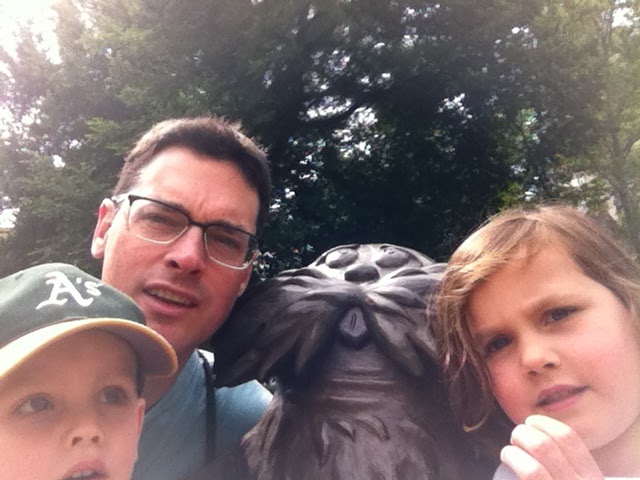
Dr. Seuss Museum

Predictions/Inquiries:
  • I predict that I'll learn about Dr. Seuss's life, some Springfield history, as well as his local inspirations.
  • Does the museum put him into any larger contexts, such as an exhibit on his cartoons from WWII?
At the Museum:

The most expensive museum that I've been to so far was the Intrepid Sea, Air, and Space Museum, which cost $28 with a AAA discount.  The next most expensive entry fee was...you guessed it, the Dr. Seuss Museum, coming in at $25.  To their credit, your entry fee does get you access to five museums  within the Springfield Museum Group, but altogether, entry is way over priced and the five museums really only add up to one.  On top of that, there was noticeable corporate sponsorship at every turn, which disrupts the flow of information and raises questions about corporate influence in planning and message thus compromising the integrity of the information.

This museum was great for kids but had little value for adults desiring something more.  If you want to see what Dr. Suess's living room looked like, or have a look at his writing desk, or learn a bit about his process then you're in luck.  But if you want a deeper story that gets into the greater significance of Seuss you'll be disappointed.  The one section that works in primary sources was a display of letters that he wrote but their main purpose is to show his real life whimsical sense of humor.  In the museum, there is a historical element for kids, as the entire downstairs is set up as a fictionalized version of the Springfield that Seuss grew up in.  However, that was way over my four and three year olds' heads.  

Family owned brewery until Prohibition, Kalmbach and Geisel.  

Sunday, July 9, 2017

Lillie's Victorian Establishment

Prediction:  This place an awesome testament to the Victorian Period.

At Lillie's:
I love Victorian stuff. I love the ornateness of the furniture, the patterns, the fabrics, and the design. So, as I walked from Pier 86 to the R/W train in Times Square, I was sucked into Lillie’s Victorian Establishment. The sign in front read “Est. 1901,” and the facade appeared to be a preserved relic from the City’s early bohemian hay-day. As I walked in, I was blown away by the detail of the place: marble bar, stained glass, lights, paintings, posters, mirrors, pressed tin ceiling, rod-iron rails, neo-classical architectural details, etc. The first thing I asked the hostess was does the place serve any drink specials popular in Victorian times, to which she disappointingly answered “no”—my first clue that something was up. 

On the menu’s inside cover is a story on the bar’s namesake, Lillie Langtry, an English born immigrant actress. She arrived to the U.S. in 1882 seeking a career in the theatre. As the story goes, after her debut the theatre burned down and the only discernable thing left was her name from the marquee lying intact amongst the ash. She went on to a long career and fame that lasted more than fifty years. Without explanation, the menu goes on to note that Lillie was “a controversial figure who challenged Victorian society’s attitudes to[ward] women” and that she was “ahead of her time.” Also presented on the menu was the establishment’s motto: “Celebrating friendship the old-fashioned way.” Further, the menu talks up the establishment’s representation as one of the last great Victorian “gin palaces” that once flourished in the industrial cities of Northern Ireland and England. Wait…what…? This is New York City, and this place was supposedly established in 1901…? Does that mean in 1901 the founder of Lillie’s was trying to recreate a scene from the “old country?”

After reading the information on the menu and admiring the material present throughout, I sought to engage the bartender to find out more. It was then that I learned that the bar had been open only five years and that most of the material present was shipped over after some Irish mansion was dismantled and its contents repurposed for the creation of this establishment. To my question, “then why does it say “Est. 1901” on the sign,” the bartender shrugged his shoulders and, in a seemingly authentic Irish accent, said, “maybe that’s when the building was built.” So, where am I? What is this? Is the place a hoax...a tourist trap…? And, was that accent real? (On a side note, of the four bartenders that waited on me in two days in NY, three had Irish accents. Is there a public appeal for Irish bartenders? Is there an appeal for the perception of having an Irish bartender, or simply an affection for Irish accents? Does that sell more drinks? Are the bartenders perhaps trying actors working on their craft? And, why Irish?)

So, while Lillie’s story may be true, the material may be real, and the scene may have been historically accurate, the reality is that this establishment is more of a piece of historical fiction than it is actual history. However, the bar certainly begs the question, is historical fiction history? Several additional intriguing questions come to mind as well: is it OK that an establishment deliberately presents itself, directly or not, being older than it is?; does the bar’s potentially deceptive presentation of itself as a 116-year-old establishment negate the possibility of it representing history at all?; does anything about the place make it a museum?

Between the real estate, the purchasing and importing of the material, the design, and the construction Lillie’s took significant capital to develop. The fact that this bar exists near New York’s biggest tourist attraction, Times Square, and in the heart of Broadway, coupled with the significant investment to build it, suggests that there is a strong market for consumption of the Victorian Period. This prompts further intriguing questions about who the intended audience is and what is behind that audience’s interest to imbibe at such a place? Do people have a romantic desire to feel as though they’ve traveled back in time? Is there a desire to feel like they’re experiencing history? Is there a significant affection or romantic affection for the Victorian Period that draws people in? Is it for tourists, theatre goers, a novelty for post-work happy hour, or unsuspecting consumers of history? For me, it was a desire to hit another historic place on my NY sojourn in addition to an affection not for the Victorian Period, but for Victorian stuff. But I’ll leave it to the reader to determine whether this stop should count as one of my summer historic site visits? Was this history? One final question: is it a bad thing that someone can walk in, have a drink, a conversation, and leave thinking they’ve actually been somewhere historic and had a Victorian experience? One more: what does this seeming affection for things Irish suggest about American history and American culture? Ok, I promise last one, but perhaps the most important one…what impact does historical fiction have on historical memory?

Riverside Church

Prediction:  This Church is big but insignificant.

At the Church:

Not being able to get a tour of the Apollo and a quick tour of Grant’s Tomb, provided some time to improvise.  Across the street from Grant’s Tomb sits Riverside Church.  I had read about and considered it for the itinerary but, despite having the highest church tower in NYC, it seemed like small potatoes historically.  But I’m glad that I ventured in because I was wrong. 

Interestingly, the Church was built in 1927 with Rockefeller money but, from what I saw, there was no celebration of that.  In the archives, much attention was given to the Priest who was influential in building the church and to the Church’s involvement in the Civil Rights and Anti-Vietnam movements.  I had no idea going in that Martin Luther King had spoken here six times and that he gave one of his most important and controversial speeches/sermons in his career, “Beyond Vietnam: A Time to Break the Silence” at Riverside.   I’ve heard excerpts from this speech many times and it is an impressive and powerful work.  It caused a backlash towards King from many angles for, in essence, unifying the Civil Rights Movement and the Anti-War movement. King saw the War’s unjust impact on the black population as they were disproportionately killed in action, compared to the rest of the population.   Like W.E.B. DuBois before him, in this speech, King pointed to the irony of African-Americans being discriminated against at home while fighting for “freedom and democracy” abroad. 


One of the most impressive discoveries during my trip to New York, was the outreach, community involvement, activism, and programming of the three churches that I visited.  At Riverside for example, their newsletter highlighted programs in June such as Pride Month, Riverside Freedom School, Riverside Arts Camp, a Divestment workshop, and a program dedicated to celebrating the 50th Anniversary of King’s “Beyond Vietnam” sermon.  The church also maintains a monthly initiative it calls Live Justice Now.  The program suggests “actions that both respond to current events and challenges of our day, and advocate[s] for greater justice for communities most vulnerable to abuse and exploitation.” The outreach at Riverside is dealing with big issues and doing real things.  It seems lighter on the dogma and heavier on mission.  To be clear, the mission is not to spread Christianity, but to better society.  Growing up in a small town in Connecticut, the church that I attended as a kid was boring, dogmatic, and had little reach outside itself.  I wonder if I would be more interested in staying involved with the Christian church had my childhood church taken an approach more like Riverside.  My hunch is that these differences stem from the inherent contrasts of urban and suburban life in the U.S.

Monday, July 3, 2017

Gouldsboro, Maine Historical Society

Prediction:  
  • The museum will highlight the history of Gouldsboro’s relationship with the sea.

At the Society:
The Gouldsboro Historical Society is more like an antique shop where the items aren’t for sale than it is a museum.  They have a great collection of artifacts and material culture that speaks to the way life was at various points of the last 8000 years, however, there is little interpretation and a narrative is difficult to discern.

Most interesting were the Native American artifacts discovered in archaeological digs in the area over the last 100 years. Thinking about the year-round demographics of the town today, it was interesting to see some of the luxury items of yesteryear.  My hunch is that there was a more defined divide between the top and bottom of the full-year residents, economically, and as a result materially, 100 years ago than there is today.

From: 1860 Topographical Map of Hancock County
Most relevant to the history of the town was an exhibit on the fishing and boat building history of Gouldsboro.  A strong relationship with the sea and its changes over time were apparent.  While lobstering has remained an important industry for over one hundred years in the town, the tools of the trade have changed along with the rules and regulations around the trade.  Boat styles and manufacturing techniques have changed as have the ways in which the sea is utilized. Prospect Harbor, a borough of Gouldsboro, was first put on maps as a place for seamen in the 1700s to get fresh water.  Also, a sardine factory once stood in Prospect Harbor and now a National Park, which bans clamming and worming on its shorelines, sits on a significant portion of Gouldsboro and what was once Gouldsboro.   


The museum has two buildings separated by four miles.  One is housed in the Old Town Hall, and the other in a former Methodist Church.  The climate controlled former church is more like an archive, housing centuries old town records, ancient books, and research done over the years.  Looking over the collections of material culture, records, and research the town values become clear:  fishing, military service, patriotism, deeply rooted families, obscurely important townspeople, the sea, and material culture that reflects the before mentioned values are prevalent throughout.   Altogether, the museum reflects a small town, with small money, that is relatively irrelevant in the grand scheme of American History.  That said, the town is proud of its history and its several connections where it and its citizens played a supporting role in big events in the greater American narrative.